
A few weeks ago, I attended an industry lunch where a welfare official spoke about children in care. They mentioned that after the government outsourced administration services, the rate of children returning to their homes had increased to 60%. The official emphasized that the best place for these children was with their parents.
Upon hearing this, I couldn’t shake a feeling of profound unease.
My memories took me back to my time as a volunteer at Salvo Waterloo, a venue that was surrounded by social housing estates. It was there that I met Mary, a woman likely in her 40s. Her face bore the marks of deformity, and she had lost all her teeth. When Mary arrived at the small charity outlet, usually in the late morning, she spoke loudly, almost as if she were shouting. Her speech was unintelligible, and the staff at Salvo prepared prescribed protein drinks for her. Mary then sat at a table by herself for hours, engaging in conversation with everyone and no one in particular.
One of the local women who resided in the same social housing estate as Mary shared a heartbreaking insight. She told me, “She was a beautiful little girl once, beautiful!” But Mary’s life took a tragic turn when she was subjected to repeated abuse by her father, resulting in severe brain damage and a disfigured existence.
My own childhood was marked by its share of harshness, with my mother wielding a bamboo stick as she chased me up and down the streets in an attempt to discipline me. It’s important to note that in those days in China, such forms of punishment were widely considered acceptable. When I endured those beatings, there was no one to come to my rescue, not even my grandmother. Yet, despite the difficulties, I consider myself fortunate. I managed to grow into a resilient and self-reliant individual. Mary, on the other hand, was denied that same opportunity.
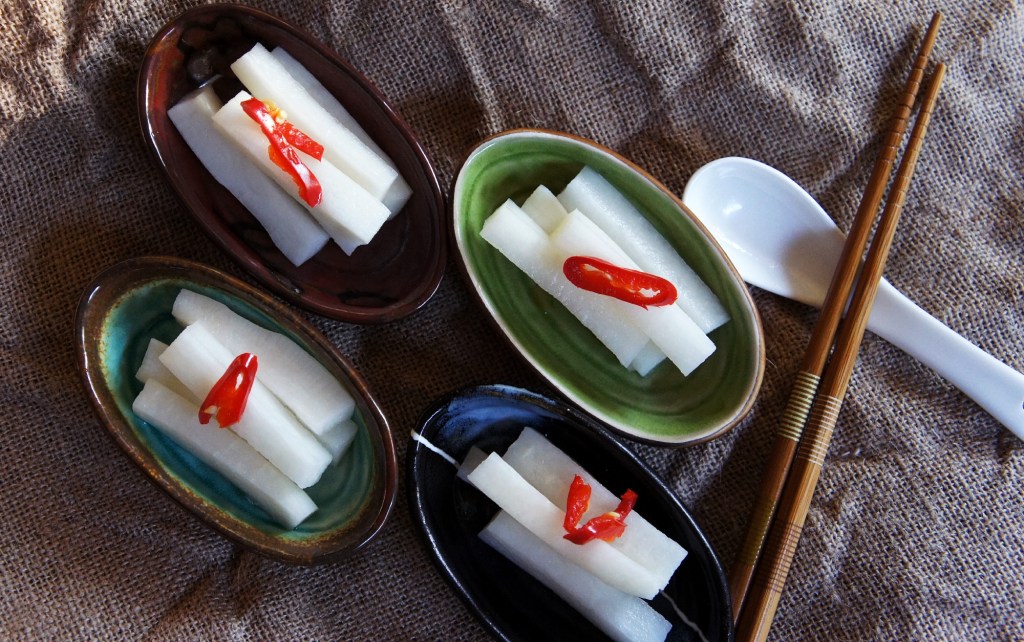
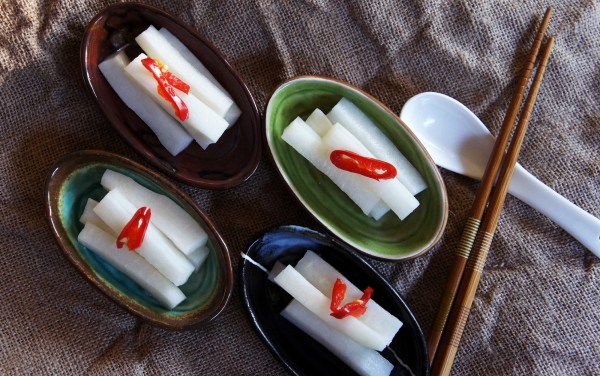
That evening, as I reflected on these memories and the stark contrast in our experiences, I decided to make a childhood snack I cherished – sweet and sour pickled white radish. I used to buy them from street vendors for just 10 cents, a rare treat when friends visited.
The sweet and sour flavours served as a reminder of my wish for all children in the world: that they may be enveloped in love and care, shielded from the harshness that life can sometimes bring.
To prepare your pickled Asian white radish, follow these steps:
You will need:
A glass container with an airtight lid, large enough to hold the radish pieces
Ingredients
Here’s a recipe for pickled Asian white radish:
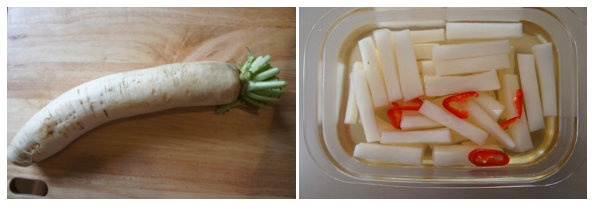
- 250g Asian white radish (white daikon), sliced
- 1/2 cup of sugar, more or less to taste
- 1 cup of rice wine vinegar or apple cider vinegar
- A few pinches of salt
- A small amount of chilli, sliced (optional)
- Warm water
Method
- In your glass container, mix the sugar, salt, and vinegar with warm water until the sugar and salt have completely dissolved.
- Add the sliced Asian white radish and chilli to the mixture in the container.
- Top up with some more warm water to ensure that all the radish pieces are fully submerged.
- Once the mixture has cooled down, seal the container tightly with its lid.
- Place the container in the refrigerator and allow it to pickle for 2-3 days. This time frame is essential to develop the best flavour; if you rush it, the radish may taste too peppery, bitter, or raw.
- When ready to serve, take the pickled white radish out of the fridge. It’s best enjoyed slightly chilled as a flavorful condiment or side dish alongside your favourite meals
Enjoy your homemade pickled Asian white radish!

 delish Home Cook - happiness is homemade
Leave a reply to 白蘿蔔買回來如何保存? – 生日優惠網 Cancel reply